Cold water splashed into the pothole from the river and struck Tarek across the face. He wiped it away with both hands, blinking against the sting, but there was no waking from this. He had barely slept for many moons, and neither had the others. Whenever exhaustion finally dragged their eyes shut, the river found them again.
Drip. Splash. Drip. Splash. Creeping over the rock, dripping into the darkness of the pothole.
They had been thrown into a hollow pothole that stood near the place where two rivers came together, their separate waters twisting around stones before joining into one broad, restless stream. Every rise in the water sent cold spray over the edge of the hole. The pothole was little more than a wound in the bedrock, deep enough that they could not climb out without help. Meltwater seeped through cracks in the stone and gathered around their feet. The pothole lacked a dry corner. Their hides were soaked through. Mud clung to their legs. The cold had settled so deeply into their bodies that nobody complained about it anymore. They pressed closer together, trying to keep the little warmth they had.
Above them, the pale morning sky appeared as a narrow strip between the walls of the pothole.
Another wave slid over the riverbank and splashed down the rock wall.
Across the pothole, Enu, even exhausted, sat with her back straight against the wall, knees drawn toward her chest, and the hide pulled tighter around herself. Her hair had dried in tangled strands against her face. When footsteps approached the pit, her entire body tightened before she could control it and immediately pull her hide tighter around herself. She stared upward without blinking, memorising faces, the sounds they made, weapons, and movements. She had begun recognising some of them by the way they walked. She hated that she could.
She never described what had happened the first night or the subsequent nights.
Neither did Sela nor Tava.
Tava tried to protect the others. Whenever the younger prisoners were frightened, she sat closer to them. Whenever Naru began to cry, she drew him against her and whispered until his breathing slowed. She checked Punto’s wound. She shared the smallest pieces of leftover food thrown into the pothole. She never complained. But there were limits to what she could protect.
Punto lay against the far wall. His wound had swollen shut around his eye. Blood had dried beneath his nose and along his cheek where the stone had cut him.
Tarek crawled toward him, asking, “Punto.”
No answer.
Tarek touched his shoulder. Punto opened his good eye.
“Still here,” he sighed.
Then a stone struck the ground beside him, splashing water at everyone.
The children cheered.
Several of them were standing along the rim, peering down into the pothole. They carried handfuls of stones, competing to see who could throw farthest. One boy laughed when his stone struck Punto’s shoulder.
He picked up the stone and tried to throw it back. The stone could not even reach the rim. His left arm had swollen badly, and a dark wound ran from his temple to his cheek from the frequent beating.
Another stone came down.
This one struck him in the ribs. Punto folded slightly.
Tarek pulled Punto beneath the shallowest part of the wall and crouched over him. Tava covered him.
The stones continued.
Tarek looked upward and shouted, “ENOUGH!”
One of them looked around at the others, waiting to see who could imitate Tarek best. They were learning each other’s cruelty.
“En-off!”
“En-cough!”
“Eh-no-guh!”
One of them even lowered his shoulders and copied the way Tarek walked and shouted, “En-oh-you-guhhh!”
The others laughed.
Another stone flew.
Tarek caught it before it struck Naru and looked at the child who had thrown it. The boy smiled.
Tarek dropped the stone. He would not give them the satisfaction. That had become the first lesson of captivity. Do not react. Do not beg. Do not show them where you hurt. If they wanted anger, give them silence. If they wanted fear, give them a face as empty as the stone beneath their feet. But there were limits to what stillness could protect.
Tarek had always believed that if something threatened his people, he could act. A spear could kill. Strong legs could run. A good hunter could find food. A clever person could find a way through a difficult trail. But there was no trail out of this pit. No animal to track. No mountain to climb. For the first time in his life, Tarek discovered a kind of helplessness against which strength had no meaning.
He swallowed, but his throat had gone dry.
He wanted to tell the others that this would end, that they would return to their valley, that the fires would still be burning when they came home.
But he did not know.
The days began to lose their names, only to be remembered by what happened inside each of them.
The day Punto’s arm swelled. The day Naru stopped asking questions. The day Enu returned, without speaking. And the days when Sela was taken away.
She had been gone for so long that even Naru had stopped asking when she would return. Tarek had stopped counting the days.
Then an adult woman’s voice rose somewhere beyond the children, and the stones stopped.
The children scattered.
As footsteps approached, Enu looked up.
Two figures appeared above the pothole. A woman and a child. The woman held an infant against her body beneath a loose hide. She looked down at the prisoners without expression. And the young boy, roughly Naru’s age, stood beside her. His dirt-streaked face still carried the softness of childhood. At first glance, he looked like one of the settlement’s children, but there was something subtly different about him. He was leaner, narrower through the shoulders, with little hair along his arms and face rather than the heavier coat common among the others. His features carried something difficult to name— a meeting of two kinds of faces, familiar and strange at once.
Then his eyes caught the light.
Blue.
A startling, clear blue beneath the dirt on his cheeks.
Not the pale grey of the winter sky, not brown earth under the melting snow, not the dark velvet of the night sky, but a clear, cold blue.
He stared down at them with the uncertain curiosity of a child who had always been treated as a stranger among his own kind. Yet now, looking into the strangers’ faces, he seemed to recognise something familiar— a likeness he had never known how to name, an unspoken belonging reflected back at him.
Then the woman threw something into the pit.
A carcass.
It landed among them with a wet thud. There was barely enough flesh left on the bones to feed one person.
Tava picked it up.
Then the river rose again.
Cold water spilt over the edge of the pothole and climbed around their ankles. Naru stumbled backwards while Tava crouched over the carcass, scraping the last scraps of meat from the bones with her fingernails. The river washed blood and bits of flesh from her hands as she worked.
When she had gathered everything she could, she divided it into five portions. She measured them with her eyes twice, then pinched a tiny scrap from one piece and moved it to another. She did it again. She made them as equal as she could.
She looked at the portion in her palm and sighed, “Sela.”
No one answered. Tava wrapped the piece in a scrap of hide and placed it against the driest part of the rock.
“She’ll need it when she returns.”
They had not seen Sela for so many nights that Naru had stopped counting. They had heard her cries on the first night. After that, nothing. No one knew whether she was alive.
Another wave struck the riverbank and splashed against the rock wall.
The boy suddenly ran toward the river. He began gathering stones.
One at a time.
He carried them to the edge of the pothole and placed them along the river-facing side. Then he returned for another. Then another. Each stone was larger than the last.
The woman watched him without speaking.
The boy’s wall grew crooked and uneven, leaving gaps wide enough for a fox to crawl through. Still, he kept building.
The river struck the wall. Once. Twice. Again. Several stones shifted. The boy pushed them back into place.
A strange humming rose from the woman. It was neither a song nor a warning, merely a low repetitive sound beneath her breath as she stood there with the infant pressed against her chest.
The boy finally stepped back. His little wall leaned crookedly against the river.
He looked down, and for a moment, his eyes met Naru’s.
Then his mother turned. The boy followed. They disappeared.
The river continued to strike the stones. Once. Twice. Again. But only a thin stream found its way into the pothole now.
The crude wall was built by small hands. It was ugly, weak and useless against a strong wave. Perhaps that was not why he built it; he just built it for them. And that was enough to make him remember that not everyone above the pit was the same.
By then, they understood the rhythm of their captivity. Morning brought the river. Then hunger. Then the children. Then the adults. Then darkness. They were not killed because dead prisoners could no longer answer questions, reveal trails, or amuse their captors.
They had captured five creatures that looked strangely like themselves, but not quite. Their bodies, weapons and strange ornaments appeared to be poor imitations of themselves, like ravens mimicking their voices without understanding their meaning. The strangers had seen outsiders before and killed them, instinctively, without hesitation. This time, something unfamiliar had stopped their hands.
Perhaps it was curiosity, perhaps fascination, perhaps bewilderment— or simply the failure of an instinctive trigger.
One hunter pressed a burning stick close to Punto’s injured hand. Punto pulled away. The hunter laughed. Another hunter tried it with Naru. Tarek lunged forward. The hunter smiled. Sometimes they simply stared, as though waiting for the strange creatures to reveal what made them different.
It was not pure cruelty. It was something colder. They wanted to understand what they had caught. And somewhere beyond the tundra, their world continued without knowing that they were trapped in a hole beside a river.
They were not taken out when they were hungry. They were not taken out when they were cold. They were not taken out when they begged.
They were taken out only when their bodies could no longer wait.
Even then, two hunters came with them.
They were led a short distance from the pit, watched while they relieved themselves, and dragged back before they could look too closely at the settlement. No privacy. No wandering.
That evening, Sela returned.
She stopped at the edge of the pit, unable to climb down. For a moment, she simply stood there, hesitating.
She looked at the wall. Then, in the darkness below. Her fingers tightened around the torn edge of her hide.
Then two of the larger strangers grabbed her and threw her into the pit like discarded leftovers.
She landed hard on her knees. Her hair had come loose. Mud streaked one side of her face, and a bruise was already darkening beneath her eye.
Tarek moved toward her. She raised a hand, and he stopped.
Sela lowered herself slowly beside the wall, pressing her back against the cold stone. For a while, she said nothing.
She was breathing through her nose, very carefully, as though even breathing too deeply might hurt.
Finally, she whispered, “Don’t ask.”
Tarek sat opposite her, “I won’t.”
Naru opened his mouth, “But I have questions…”
Tarek reached over and gently covered his mouth, “Not this time, lad.”
Naru frowned at him. Tarek left his hand there for another second. Then he removed it. Naru did not ask again.
A few moments passed. Somewhere above them, water dripped from the cracks of the wall.
Plink.
Plink.
Plink.
Sela stared at the sound as though she could disappear into it.
Then she said, “Don’t look at me differently either.”
Tarek swallowed, “I won’t.”
She finally looked at him.
For an instant, Tarek saw the old Sela there— the woman who could stare down a wounded wolf. Then the look vanished.
“Promise.”
“I promise.”
She held his gaze for a moment longer, searching his face for something.
Pity. Fear. Disgust. Anything. Apparently, she found none.
She closed her eyes.
That was all.
She had always been the one who spoke when the others remained silent. She could fill a cold night with stories, argue with hunters thrice her age, and laugh louder than anyone around the fire. Now she rarely spoke at all.
No one spoke. The bruises told enough. The silence told more.
Then Sela placed a hand against her belly. It was almost absent-minded.
Tava noticed. So did Naru.
Without a word, he reached into Tava’s hide and took the small portion of food that had been meant for her. He held it out to Sela.
Hunger had become ordinary for Sela. So had pain. So had waking from dreams with her teeth clenched and her hands gripping the cold stone.
She took a bite, chewed, and swallowed. Then another.
Her stomach lurched.
She bent forward and vomited onto the rock.
Another wave seized her. She retched until there was nothing left but strings of saliva and the bitter emptiness of an empty stomach.
Tava reached for him and gently lowered his hand.
Sela wiped her mouth with the back of her wrist.
Then she felt Tava’s eyes on her.
Tava’s gaze moved from Sela’s face to the hand resting protectively over her belly. Then to her face. Sela lowered her gaze. Neither woman said anything. Then Tava shifted closer and sat beside her. Their shoulders touched. Sela moved closer too. For the first time in days, the three women sat together.
Above them, the river continued to splash against the loosely built wall.
The following days blurred into one another.
The strangers discovered new ways to amuse themselves, their laughter and games filling the hours with a strange, restless energy. Sometimes they threw pebbles into the pit and laughed when someone ducked. Sometimes they shouted words the captives did not understand and laughed even harder when Naru tried to repeat them. Every morning, the children came to kick at the wall until it crumbled. And every morning, the boy quietly rebuilt it.
No one asked why he bothered.
No one seemed to care.
By noon, the wall stood again—sometimes crooked, sometimes taller, sometimes strangely beautiful in places where he had fitted the stones perfectly.
One night, beneath the crescent moon, footsteps approached. The orange glow from burning sticks slowly lit the pit’s wet, dark walls.
The captors had returned, and everyone fell silent.
Not calm. Still. As though stillness itself had become a hiding place.
Tarek had spent years learning stillness. A hunter learned to freeze when an animal was near. To breathe without moving the leaves. To wait until the right moment. Only now did he understand the difference between being still and being powerless.
He could endure the stones. He could endure hunger. He could endure pain. But he could not endure watching the people beside him disappear piece by piece.
Three hunters appeared above them.
They spoke no language the captives understood, but their gestures needed no translation. A spear pointed toward them. A finger pointed toward the sabretooth tooth. A hand swept across the valley.
The meaning was clear.
When one pointed toward Tava, the others laughed.
Tava pushed himself against the wall.
Tarek stood, “Leave her.”
The hunters laughed. Another said something, and the first shook his head and descended into the pit.
Punto moved before Tarek could stop him. He swung with his good arm. The blow landed.
For half a heartbeat, nobody moved.
Then the bulky stranger struck him. Once. Twice. Again. Until Punto collapsed.
When Tarek lunged, another stranger caught him from behind.
“Tava!”
Enu grabbed a stone.
The stranger holding Tarek twisted her arm until the stone fell from her hand.
She had been one of their finest hunters, perhaps the best. She had crossed rivers in winter. She had slept beneath open skies. She had faced animals that could tear a man apart.
Now the sound of approaching footsteps could drain the colour from her face.
Then the strangers grabbed Tava, and she fought.
Not wildly. Not uselessly.
She fought with the stubborn, deliberate strength of someone who still believed her body belonged to her. She twisted, kicked, and drove her heels into the wet stone, refusing to make their work easy.
Tava struck again. She spat at his face. The stranger recoiled, more surprised than hurt.
Tava turned toward the others, her hair falling across her eyes, her breath coming in sharp bursts.
“Don’t touch me!”
The words meant nothing to them, but the refusal did. They seemed to be having fun.
They grabbed her again.
For a moment, they could not move her. Her whole body trembled with the effort. Her knuckles whiten around the stone. For a moment, he saw the woman she had always been— not afraid, not obedient, not broken.
She looked at him. Not pleading. Not surrendering. Furious.
The strangers pulled harder.
Her fingers slipped. She caught the stone again. Then another pair of hands seized her from behind.
Four of them now.
Still, she fought. She kicked. She twisted. Her screams echoed in a language they could not understand.
They dragged her upward inch by inch. Her fingers clawed at the wet stone as they dragged her toward the edge.
Tarek broke free and caught her wrist. For one moment, they held each other.
“Tarek.” sighed Tava.
He tightened his grip and shouted, “I’ve got you, Tava.”
He believed it. For that one second, he believed it.
Then the stranger drove the wooden shaft of his spear into Tarek’s ribs.
Pain exploded through him.
His fingers loosened.
Tava disappeared over the edge.
“Tava!”
Tarek fell to his knees.
Then Naru whispered from the darkest corner of the pit in tears, “They’re going to kill her.”
Tarek looked toward the sky in pain, “No.”
“How do you know?”
Tarek did not answer.
He had no answer.
Morning came without her.
When the children arrived, they brought a new game. One carried a strip of dried gut. Another carried a large piece of meat.
They tied the meat to the gut rope and hung it over the edge of the pit, just beyond the captives’ reach.
The children crouched at the rim, watching.
Waiting.
One of them pointed at Punto. Another mimicked jumping. They laughed. And before leaving, they stuck to the morning ritual and kicked down the wall the boy had built the previous day, sending stones tumbling into the pit.
Then an adult voice called from somewhere beyond the pit, and the children scattered, leaving the meat hanging overhead.
For a while, nothing moved.
Then the boy appeared.
He came alone, carrying the infant. He looked older than he had yesterday.
Not taller. Not stronger. Just older.
He stood at the edge of the pit and murmured something to them. No one understood the words. But they understood his face. Tears ran down his cheeks.
He glanced behind himself.
Then he released the gut rope.
The meat dropped.
It landed beside Naru.
The boy immediately turned and disappeared. He did not build the wall that day. He did not even bother looking at it. The stones lay scattered in the mud, and for the first time since they had known him, the boy left them where they had fallen.
“He didn’t build it,” Tarek whispered.
No one answered.
Naru stared at the food and picked it up.
He tore it into pieces.
“One for Enu. One for Sela. One for Punto. One for Tarek.”
A pause.
“One for Tava.”
The boy who had once asked questions about mammoths, mountains, and the stars had begun dividing food before eating it. Tarek remembered Naru asking him, only weeks ago, whether the stars ever fell into the puddle. Naru had been certain they did.
“Otherwise,” he had said, pointing excitedly at the water, “how do they get inside?”
He had wanted to wait beside a puddle and catch one. Tarek had laughed then. He had told him that puddles only borrowed the sky.
Now he was measuring meat. Five pieces for the others. One for himself, the smallest piece.
His breath caught, and a tightness spread beneath his ribs. The world was teaching Naru things he should never have had to learn. And Naru was learning quickly.
Later that day, when the Sun was overhead, two hunters threw Tava back into the pit.
Every night, the moon grew thinner, shedding its light until only a silver thread remained above the river. And in those darkening nights, a plan began to take root— not spoken aloud, but passed between glances, held in silences, and guarded carefully behind lowered eyes.
They had gathered every stone that had fallen into a pothole, every stone the children had thrown, every fragment of rock loosened by the river became useful. They became another step toward the rim.
Tarek arranged the largest at the bottom, Punto fitted the flatter ones into the gaps, and Tava tested each layer with her weight before they added another. Enu watched out for the prying eyes. It was ugly work, slow work, but after many days, a rough sloping mound of stones had risen almost to the lip of the pothole. They could climb out now. Not easily, and not without being seen, but they could.
Tarek climbed. His fingers reached the upper edge of the pothole. For the first time since their capture, he could see beyond the rim without looking upward.
The rivers. The fires. The shelters. The trees beyond the settlement. The eastern mountains. Everything was in his optical range.
They took their turns and peeked into the outside of that curved wall pit.
Beyond the settlement, the land opened between the hills into a wide, beaten corridor of trampled grass and hard-packed earth. Trees along the edges leaned away from the opening and bore scars high above a man’s head.
Freedom was no longer an idea. It had become a distance he could measure.
They had chosen the new moon because darkness would be deepest then. Tomorrow night. One more day. Just one more rock away. They would climb after the giants slept, cross the river, and disappear into the darkness. It was a fragile plan, but better than the pit of hopelessness.
That morning, however, the plan died before the Sun reached its highest point. The children did not come that day.
The boy and his mother had stopped coming days ago. The hunters had not taken the girls out. They had not eaten anything for three days. The prisoners had become bored.
That was worse.
Instead, four hunters appeared above the pit. Spears descended first. Then hands. They knew immediately that something had changed. They dragged Punto out. Then Enu. Tava. Naru. Tarek came last, with two spear points pressing between his shoulders.
They were led through the settlement while people gathered around them.
Children came first. They followed in a loose, laughing pack, pointing, whispering, tugging at one another’s arms whenever one of the captives stumbled. Some mimicked their walk. Others called out words the captives did not understand.
A piece of bone came sailing through the crowd and struck Enu across the back of her thigh. She flinched but did not turn. Another child darted close, fingers reaching for Naru’s hair.
Tarek caught the boy by the shoulder and pulled him against his side.
“Stay close.”
Naru obeyed, and Tarek kept one arm around him as they walked.
The camp seemed strangely quiet beneath the noise. The laughter, the shouting, the slap of bare feet against the earth— all of it felt muffled, as though the settlement itself were holding its breath.
The girls no longer looked at them. Their eyes moved through the settlement.
Every few steps, another memory rose from the earth. A low hide shelter crouched beneath the wind. A particular stone worn smooth by countless feet. A torn hide hanging from a wooden frame. A patch of flattened grass. A shallow depression beside a dying fire. Places where they had been dragged at night. Places where they had waited for footsteps. Places where they had learned to stop screaming. Places their bodies remembered.
Every dark corner seemed to breathe.
Enu’s jaw tightened until a muscle flickered beneath her cheek. Tava lowered her eyes. Sela’s steps faltered, only for a heartbeat. Then she kept walking.
Faces watched from every direction.
Curious faces. Amused faces. Suspicious faces. Some were expressionless. Others smiled.
And among them, the boy with the infant against his chest, staring at the captives without laughing. His eyes met Tarek’s. For a brief moment, neither moved. Then he looked away. Tarek did too.
They were led into the centre of the settlement, where dozens of people had already gathered. Children watched from behind their mothers. The prisoners were placed in a rough circle.
Nobody spoke to them. Nobody questioned them. Nobody cared. That was worse.
Then the crowd parted, and one of the hunters struck Punto across the back, and he fell to one knee.
Another grabbed Tava.
Enu twisted free for half a heartbeat before a hand caught her hair.
Naru screamed.
Sela was dragged beside them, her eyes burning as she scanned the crowd, while Tarek stood rigidly at the centre, the sabretooth fang cold against his chest.
They had reached the heart of the strangers’ world, and Tarek felt the weight of their eyes before he saw them. HE looked at Punto. Punto looked back. No words passed between them. None were needed. They both understood.
The wonderment was over.
The strangers no longer watched them with curiosity. No one lingered to study their faces or gestures. The amusement had drained from the camp. Whatever fascination had kept them alive had finally burned itself out.
The giants had grown bored with their meek prisoners.
And bored men with spears did not need a reason.
Tarek’s fingers curled into nothing. No weapon. No path. No plan. Only the cold weight of the realisation was settling inside him.
Then a spear struck the ground at his feet.
Tarek flinched.
The shaft quivered.
Before he could make sense of it, another spear came flying and struck the earth inches from his toes.
He looked up, and another followed. It landed inches from his toes.
The crowd roared.
Tarek looked down at the spears. They were theirs.
Not like the heavy spears the strangers carried. These had smaller stone points, shorter shafts, and lighter wood. They were hunting spears —made to be carried quickly, thrown farther, and recovered easily.
He looked up at the hairy strangers surrounding him.
Why were they throwing them? Had they missed?
Tarek’s eyes moved from face to face. Were they going to kill him? Were they warning him? Were they challenging him?
A man stepped out from the crowd, and the noise changed. The laughter disappeared beneath a deeper roar.
The man was enormous.
His body was covered in scars and coarse hair. Long pale scars crossed his chest and arms, winding over his skin like mammoth trails carved into earth. One ran from his left shoulder diagonally across his ribs. Another disappeared beneath his beard. His big nose had been broken more than once.
He stopped several paces away. Then he beat his fist against his chest.
Once. Twice.
A wall of sound crashed around Tarek.
He stared at the man.
The stranger pointed at him. Then pointed at the spear lying beside Tarek’s foot. Then pointed at himself. He spread his arms. Bent his knees. Mimed a thrust. Then gave a guttural roar that made Naru shrink behind Tava.
Tarek’s confusion slowly gave way to understanding.
A challenge.
They wanted him to fight.
Tarek’s hand instinctively went to the sabretooth tooth hanging against his chest. The tooth was still there. Still tied around his neck. Still carrying the memory of the animal he had killed. Or perhaps the memory of the animal that had nearly killed him.
For a heartbeat, he remembered another place. Snow. Blood. Oruk. The cat’s breath steams in the cold.
Then the memory vanished beneath the roar of the crowd. The crowd began to chant. The sound rose and fell like a storm breaking against the hills.
There were too many of them. Too many weapons. Too many eyes.
Children sat on shoulders to see better. Men leaned forward with spears resting against their thighs. Women stood behind the hunters, watching with unreadable faces.
No one looked away.
The scarred man stepped closer.
Tarek looked at his hands.
They were the size of Tarek’s head. His thighs were thick as tree trunks. His shoulders seemed too broad for the hide wrapped around them.
Tarek looked down at himself. His ribs still throbbed where the spear shaft had struck him. His legs felt hollow. His mouth was dry enough that swallowing hurt. His vision flickered at the edges.
Punto caught his arm.
“Tarek!” His voice was low, “Don’t.”
Tarek looked at him.
Punto tightened his grip.
“You can’t fight that man. You haven’t eaten properly in three days. You haven’t slept properly in longer.” He glanced at Tarek’s shaking hands and continued, “You can barely stand.”
Enu stepped closer.
She looked past Tarek at the scarred stranger, studying his feet, his shoulders, the way he held his spear. Her eyes moved constantly. The distance between them. The position of the hunters. The spears were lying around the circle. The gaps in the crowd. The direction of the wind.
Everything.
“You’re tired,” she said quietly, “He isn’t.”
Tarek said nothing.
“Don’t fight him head-on,” she said. Her eyes narrowed as she continued. “Look at him. He knows you can barely stand.”
Tarek frowned.
Enu pointed toward the man’s feet, “Watch them.”
The stranger shifted his weight. His right leg dragged slightly, and Enu noticed.
“There.”
Tarek followed her gaze, “A bad knee?”
“Old injury. Look at the way he turns.”
The stranger turned toward the crowd. His right foot planted a fraction later than the left.
Enu’s eyes narrowed, “He favours it.”
Tava moved in front of Tarek.
For once, her voice was not soft.
“No.”
Tarek looked at her.
She continued, “No. You don’t have to prove anything to them.”
A strange sound came from behind them.
A laugh.
Sela.
She had been silent. Now she walked toward the nearest spear. Her fingers closed around it.
“Sela.”
She did not answer. Her eyes moved slowly across the men gathered around them. Men who had dragged them through the mud. Men who had beaten Punto. Men who had thrown them into the pit and left them hungry, cold, and terrified. Men who had taken from them whatever they could. They had turned their suffering into a spectacle and their pain into a game, with laughter in their throats.
Her fingers tightened around the spear until her knuckles whitened.
Tava reached for her, “Sela.”
Sela’s lips trembled. Not with fear. With rage. She lowered her shoulder. Then charged.
“Sela!”
She ran straight toward the giant.
The crowd erupted.
The stranger turned.
His spear came up.
Tarek lunged after her.
He caught Sela around the waist just as she broke into a charge. Her momentum carried them both sideways. He twisted, taking the fall himself, and they crashed into the mud, throwing splashes in every direction.
Before Sela could scramble up, Tarek held her down.
“Stop!”
Sela struggled beneath his grip, snarling, “Let me go!”
“No! You’ll die!”
“I don’t care!”
Tarek tightened his grip.
“We do!”
That stopped her.
For one heartbeat, they stared at each other.
Then a small voice came from behind them, “You can beat him.”
Everyone turned.
Naru stood there with a spear almost as tall as he was.
Naru pointed at Tarek and continued, “You killed a sabretooth with a TWIG.”
Tarek blinked.
Naru continued, completely serious, “And that fox.”
He pointed at Tava, “You could have killed that lone wolf, too, if Tava hadn’t told you to stop chasing that.”
Tava stared at him, “Naru, that is not bravery?”
Naru shot immediately, “Then what is bravery?” and turned to Tarek, continuing, “You always win.”
Punto gave a dry laugh, “He remembers only the victories.”
Naru shook his head.
“I remember the teeth. Teeth that kill mammoths.” He pointed at the sabretooth tooth hanging against Tarek’s chest and continued, “Teeth that you kept for a trophy.”
Then he looked toward the enormous stranger, “He only has a spear.”
A tiny smile touched Tarek’s mouth. His gaze held his.
“Come back.” said Tava.
Tarek nodded.
Behind them, Sela picked up her spear again. This time, she did not charge. She simply held it. Watching. Waiting.
Enu moved beside her.
“If he falls,” Enu whispered, “we run.”
Sela looked at the giant, “No.”
Enu glanced at her, “We run.”
Sela’s jaw tightened. Then she looked at Tarek.
“If he falls,” she said, “I kill the bogus.”
Enu did not argue. Tava heard her. Neither did she.
Across the clearing, the giant raised his spear.
The crowd fell silent.
Tarek planted his feet. His stomach was empty. His ribs hurt. His hands trembled. But behind him stood four people who had survived because they had refused to abandon one another.
Tarek tightened his grip.
The giant roared.
Tarek stepped forward.
The giant came at him.
His first thrust was brutally fast. Tarek twisted aside, and the stone point scraped across his ribs. Pain flashed white through his body. He stumbled, recovered, and swung his spear low.
The giant jumped back.
The crowd roared.
Tarek struck again.
This time, the giant caught the shaft with one hand.
For a heartbeat, they stood locked together, each pulling in opposite directions. Tarek’s feet slid through the mud. The giant grinned.
Then he yanked.
Tarek flew forward.
He hit the ground hard.
The crowd erupted.
The giant raised his spear.
Tarek rolled.
The stone point punched into the earth where his chest had been.
Enu shouted, “His leg!”
Tarek kicked the man’s injured knee.
The giant staggered and swung his spear.
Tarek ducked.
The fist passed over his head with enough force to stir his hair.
Tarek drove his elbow into the man’s ribs.
Once.
Twice.
The giant roared and grabbed him by the hide at his shoulder, lifting him half off the ground.
Tarek’s feet kicked uselessly.
Then the earth moved. Not just beneath Tarek’s foot. Everywhere.
The stones around the fire trembled. A low vibration passed through the settlement, so deep that Tarek felt it in his teeth.
Then came another.
Stronger.
The ground rolled beneath them. The fires jumped.
Then came the sound. A low, distant rumble. Not thunder. Too steady. Too many.
A woman screamed.
The giant released Tarek, and he fell backwards.
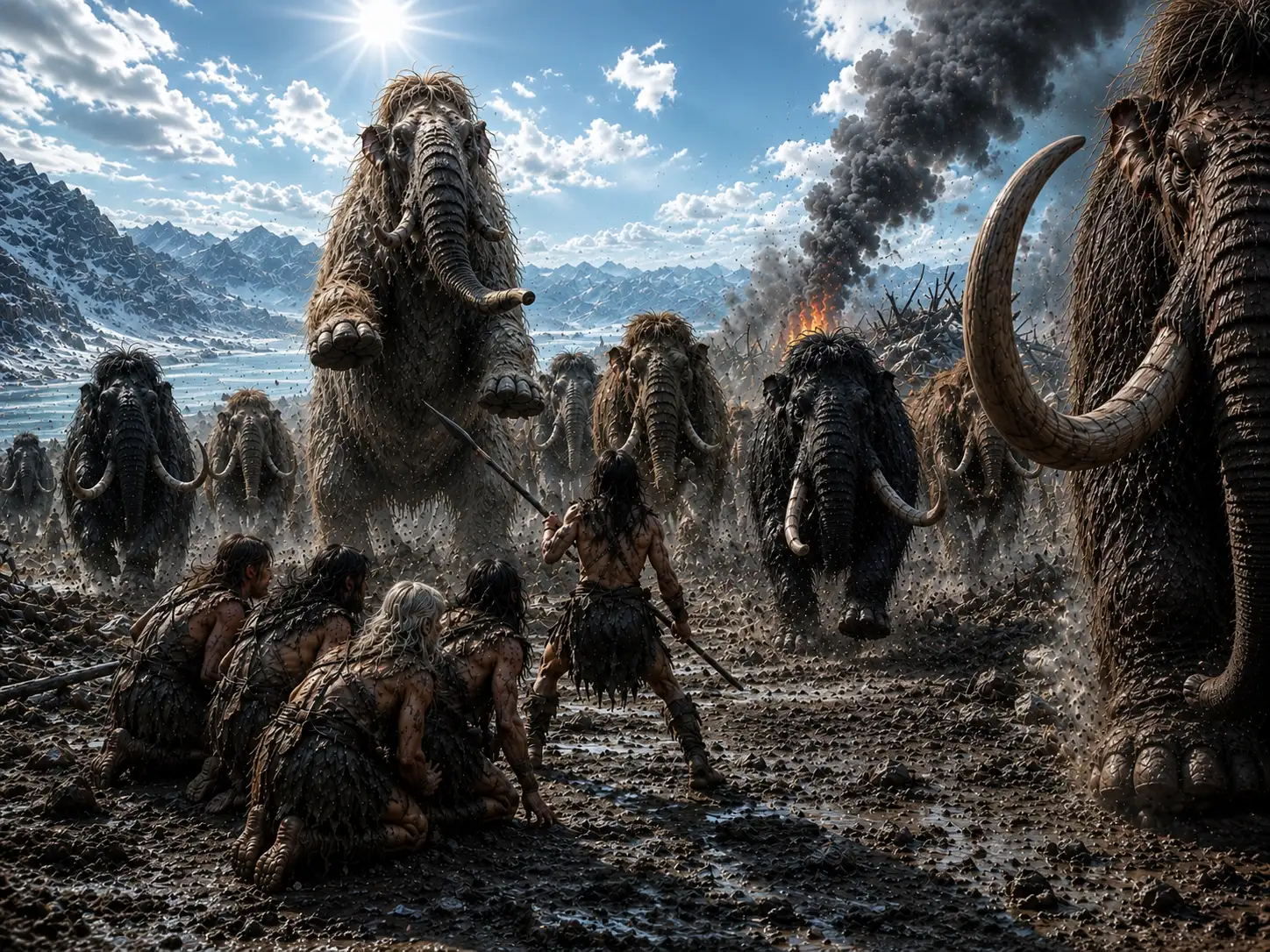
Beyond the outer shelters, something enormous crashed through the trees. Branches snapped. A tent disappeared beneath a wall of moving shades of brown. Then another.
The crowd turned as one. For a moment, nobody understood what they were seeing.
The first mammoth appeared between the two tents. Then another. Then ten. Then a moving wall of them. An entire horizon seemed to move.
Their great bodies surged through the trees, throwing snow and dead branches into the air. Tusks flashed between trunks. Trunks snapped beneath shoulders. The ground seemed to rise and fall beneath every step. They were not fleeing. They were not wandering. They were moving with the terrible, irresistible purpose of a herd driven by something stronger than fear.
The old females came first, massive and deliberate, their trunks sweeping low across the ground as they searched for the safest passage. Their ears flared at every unfamiliar sound.
A huge grey female with one torn ear led a cluster of calves against their legs.
Small calves stumbled between the adults, their trunks still too short to reach the snow. One slipped on the wet ground and squealed. Its mother immediately turned, curling her trunk around its body and pulling it upright.
Behind the females came the younger bulls, restless and nervous, tossing their heads whenever the crowd surged. One struck a wooden post with its tusk simply because it was there, splintering it into the air.
Then came the bulls.
They moved differently.
Large males with enormous heads and shoulders, their wool dark with sweat despite the cold. Their ears were pinned back. Their trunks swung violently from side to side. Thick streams of moisture ran from their mouths, freezing at the edges of their long hair. Some had bloodshot eyes. Others carried mud across their flanks where they had rubbed against trees and stones. One bull shook its head and sent clumps of snow flying from its tusks.
The smell reached Tarek before the animals did.
Wet fur. Mud. Animal musk. Something sharp and heavy in the air.
The largest bulls were in musth.
Tarek did not know the word for it, but he knew the look.
They were not angry. They were consumed by something.
One black-coated bull stopped beside a tree and pressed its forehead against the trunk. A dark fluid streaked down the sides of its face from glands behind its eyes. It shook its head, tore the bark away with its tusks, gave a roar and charged.
The first shelter disappeared beneath its feet.
The people inside had barely had a chance. The animal did not slow. Its enormous feet struck the earth one after another, crushing wood, stone and bodies together beneath its weight. A second mammoth followed, tearing through the same shelter, while a third swung its head and sent a wooden post spinning across the camp.
The mammoths followed no human boundary.
A reddish female pushed through the smoke, trunk raised, screaming for a calf. When a woman came between her and her calf, the female charged, and the woman slipped and disappeared beneath the stumps.
One mammoth ran straight through the camp without looking at anyone. Another stopped beside a fallen shelter, confused by the noise, before turning and following the herd.
A hunter threw his spear. It struck thick wool and fell harmlessly to the ground.
The mammoth turned. Its trunk curled upward and screamed. When it charged, the man ran. He had made barely three steps, and the mammoth caught him with its tusk.
Tarek looked away.
Another swept a man from his feet with its trunk and flung him into the mud.
The giant who had been fighting Tarek stared at the approaching herd. His face changed.
Fear. Pure and immediate.
The settlement that had seemed so enormous from the ridge became a maze of movements: collapsing shelters, burning wood, crying children, terrified people and moving mountains of fur. The air was filled with smoke and dust. Mammoths trumpeted over one another, their calls overlapping until the entire valley seemed to roar.
Nowhere was safe.
Tarek scrambled toward his companions.
“Run!”
Nobody needed telling twice. Tava grabbed Naru.
Tarek stayed close behind them, watching both the animals and the hunters. The chaos had given them freedom, but it had not made them invisible. Their captors were running too, but some had remembered their prisoners, while others were escaping, and those who could not do either were vanishing beneath enormous feet.
A spear struck the ground where Tarek would have stepped next. He looked ahead and found one of their captors was coming towards them with a raised spear.
Then a mammoth struck the shelter beside them, and the man vanished beneath the falling frame.
Tarek did not wait to see what happened and shouted, “Left.”
They ran.
They ran toward the river. A mammoth blocked the way. They turned. Another appeared between the tents. They turned again.
The ground shook with every step. Naru stumbled. Tarek grabbed Naru by the shoulder and pulled him away just as a tusk swept through the space where the boy had been.
“Keep moving.”
The herd seemed to be everywhere. There was no direction any more. Only movement.
A grey female thundered past. Then a young bull with short tusks. Then a dark male charged through a shelter, sending burning branches into the air.
Tarek ducked.
Then he heard the loud thunder behind them and looked back.
A mammoth was coming straight toward them.
Its hair was pale beneath the snow, almost golden in the morning light. Its breath poured from its trunk in white clouds. One tusk curved proudly from the left side of its face.
The other was shorter. Broken. Rounded at the tip.
Tarek stopped breathing. Something inside him went still. He knew that tusk. Something familiar about that face, too. Not the face itself, perhaps, but something in the eyes. Those small eyes remained fixed upon him, and he could not move.
The mammoth thundered closer.
Ten strides.
The ground jumped beneath them.
Five.
Tava screamed.
Three.
“TAREK!”
Tava’s scream barely reached him.
The blond giant lowered its head.
For one terrifying instant, the blond giant reared against the white sky, its enormous feet tearing into the earth as snow, dirt, and stones exploded beneath it.
Then— It rose, lifting its forelegs clear of the earth.
It seemed to become larger than it had any right to be.
Its trunk curled above the smoke. Its belly appeared against the white sky. Its tusk pointed toward the Sun. Its long hair streamed from its flanks as though the wind itself had caught fire.
The herd moved around it. Men ran beneath its shadow. Tents collapsed. Snow spiralled through the air. And in the middle of it all, the great animal towered over Tarek and the others like a mountain of fur.
Nobody moved.
Nobody breathed.
The sabretooth killer looked up.
The lord of the tall grass looked down.
For a heartbeat, the entire world seemed to hold still.
Then it came down.
BOOM!
Its feet struck the earth on either side, throwing snow outward. The impact knocked Tarek onto his back. Naru fell beside him. Tava screamed. But the feet had not crushed them. They had landed around them.
The mammoth lowered its head. Tarek stared into its small dark eye.
The great trunk descended. Slowly. Not like a weapon. Like a hand searching through memory. It stopped above him.
The mammoth inhaled.
A deep breath.
Then another.
Warm air washed across Tarek’s face. He smelled wet hair. Mud. Grass.
The old, bitter scent of an animal that had lived through many winters.
The trunk moved closer. It brushed his hair. Touched his shoulder. Then paused at his chest.
The sabretooth tooth hanging there trembled against his skin.
The mammoth inhaled.
Once.
Again.
And then it stopped.
The enormous head tilted. The ears relaxed. A deep sound rolled from somewhere inside its chest.
Not a trumpet. Not a warning. A low, almost gentle rumble.
Recognition.
The mammoth inhaled again. And Tarek understood. It remembered his smell.
Perhaps not his face. Perhaps not his name. Perhaps not even the winter when their paths had crossed. But somehow, somewhere beneath piles of snow, blood, grass, and distance, the scent had remained. Remained as a memory.
Tarek’s breath caught.
“You…”
The word barely escaped him.
Then a larger bull roared somewhere behind it.
The mammoth turned sharply. Its ears spread. It looked once more at Tarek. And then it crashed through the remaining shelters, scattering people and timber, and disappeared into the raging herd.
Tarek remained on the ground, staring after it. He did not know whether the honey-haired giant really remembered him. He did not know whether this was recognition or merely instinct. But he knew what he felt.
Punto reached him.
“Move!”
They ran.
They did not look back.
They crossed the river through water up to their knees, climbed the opposite bank and disappeared among the rocks. Behind them, the settlement continued to collapse beneath the herd. The mammoths moved through it like a storm that had learned how to walk. By the time they looked back from the ridge, the fires were scattered, the shelters were broken, and the valley was hidden beneath drifting smoke.
They kept moving until the sounds disappeared.
Only then did they stop.
They did not understand what they had just passed through until they reached the ridge above the valley.
The broad opening through the pines and willows was not a valley at all.
It was a trail.
They had noticed the marks before but never understood them. A trail worn into the earth by thousands of stumps, year after year. For ages.
Their huge feet had flattened the grass, pressed the soil hard, and carved the route between the hills. Even now, long after a herd had passed, the ground remembered them.
Perhaps Haruk’s giants did not know. Perhaps they did. Perhaps they had not chosen the place merely because of the water. They had built their camp beside the ancient trail so the mammoths would come to them, and they would not have to chase those fur-covered mountains across the tundra. They must have lived beside the migration corridor and had benefited from it. Their familiarity has simply bred complacency.
But this time, the fur mountains did come— with a storm that brought the world crashing down around their feet.
For a while, they stood watching the mayhem. Then Tarek turned away. There was nothing more left.
Their feet were swollen. Their bellies were hollow. There were no spears in their hands now. No stones. Nothing with which to bring down even a hare.
But they still had their eyes.
Eyes that knew which berries were sweet and which would make the stomach twist. Eyes that could find roots beneath disturbed earth, tender shoots beneath stones, and small bulbs hiding in the grass.
Tava led them.
Whenever she spotted something, she stopped, knelt, and dug with her fingers. Sometimes she found nothing. Sometimes a handful of berries. Sometimes a pale root no longer than a finger.
They ate them immediately.
A berry each.
A mouthful of root.
Then they walked on.
Their hunger never left, but it became less sharp.
They slept beneath rocks, close together, waking whenever the wind moved through the grass. Nobody complained. Nobody spoke much about what had happened.
They walked west for two days, and then the land began to change beneath their feet. The open ground gave way to familiar slopes. The wind carried smells they had not noticed for so long that they had forgotten they knew them.
Smoke.
Wet grass.
Woodsmoke.
Home.
They climbed the last ridge at sunset.
And there it was.
Their valley.
The river curled through it, silver beneath the fading light. Smoke rose from the familiar shelters. Fires glimmered in the dusk.
Nobody spoke.
Tarek stood, looking down, then looked back towards the eastern mountains; they were still there.
So much had happened, yet nothing had changed. The valley looked indifferent, exactly as it had before. The hills were the same. The reindeer still moved across the distant slopes, and the wind still bent the grass in long silver waves. Yet nothing looked as it had before.
That was the strangest thing.
He looked at Punto’s wounded arm. At Enu’s tired face. At Tava’s hands were stained with berries and earth, and at Sela, standing slightly apart, one hand resting quietly against her belly. Then he looked at Naru. The boy was staring at the valley with wide eyes.
For a moment, Tarek remembered another boy at another pit, building a wall stone by stone. He wondered what had become of him.
Naru was the first to run. He ran until his legs gave way, then stumbled up and ran again.
Tarek followed.
Behind them came Enu, Tava, Punto and Sela.
Tarek looked once toward the eastern mountains. Then he turned away.
They went home.
© 2026 Dr. D
© 2026 Dr. D
© 2026 Dr. D
© 2026 Dr. D
© 2026 Dr. D
Thank you for your comment!
Comments